Please fill out the following information to receive our action alerts and our newsletter!
If you tell us where you live and skills you have, this helps us with organizing.
E-mail address:
Name,Volunteer Interests,Skills,Languages:
City:
State:
Country:

Please help Support the Campaign to Stop Killer Coke


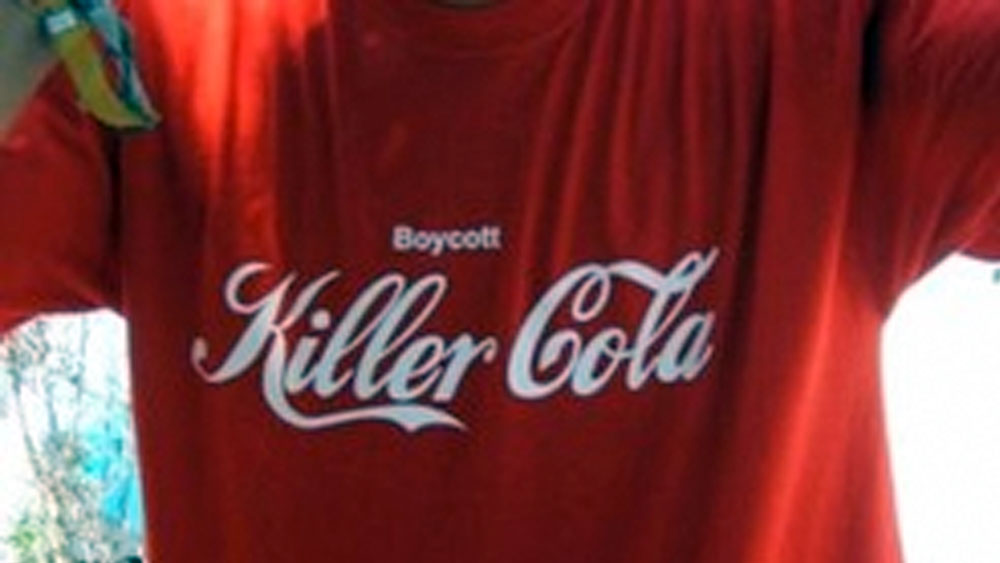
The Campaign to Stop Killer Coke now has tee shirts for a donation to the campaign.
These union-made tee shirts are 100% cotton, pre-shrunk and 100% sweatshop-free from No Sweat Apparel.

Article in the Yale Globalist on tee-shirts


Click here to see information on how to get a tee shirt.


BREAKING NEWS

Press Release, "Groundwater Levels Continue Downward Spiral Around Coca-Cola Plant: Continues Bottling in Drought Area, Farmers and Villagers Left Without Water," India Resource Center, March 11, 2010
Read Release
"The Coca-Cola company has continued to operate its bottling plant in Kala Dera in Jaipur, India even as the area has been declared a drought area last summer and the groundwater levels are falling sharply – leaving the largely agrarian community with severely restricted access to water. Data obtained this week by the India Resource Center from the Central Groundwater Board, a government agency, confirm that groundwater levels in Kala Dera fell precipitously again – a drop of 4.29 meters (14 feet) in just one year between August 2008 and August 2009, from 30.83 meters below ground level to 35.12 meters respectively."

Groundwater Levels in Kala Dera - Before and After Coca-Cola Started
Operations in 2000

Source: Central Groundwater Board, Rajasthan Groundwater Department

Bob Perillo and the Lawsuit against Coca-Cola in Guatemala

Bob Perillo responds to USLEAP's rebuttal to the letter below
Read the Perillo response

Letter from Bob Perillo, former Latin America liaison for U.S. Labor Education in the Americas Project (USLEAP) regarding the lawsuit against Coca-Cola for human rights abuses in Guatemala. Mr. Perillo highlights the involvement of USLEAP, Ron Oswald, General Secretary of the IUF and Stan Gacek, presently with the AFL-CIO International Affairs Department, among others, in running interference for Coca-Cola in efforts to suppress this lawsuit.
Read Letter in English
"On Thursday, February 25, 2010, International Rights Advocates, a non-profit human rights organization, and the Conrad and Scherer law firm filed a new civil lawsuit against The Coca-Cola Company. The case involves a campaign of violence against two Guatemalan trade unionists and their families — including rape, murder, and attempted murder —at the behest of the management of INCASA, the owner of two Coca-Cola bottling plants and an instant-coffee plant (which also produces Coca-Cola syrup for fast-food restaurants) in Guatemala. The complaint against Coca-Cola can be viewed at http://www.killercoke.org/cokeguatcomplaint.doc. The two trade unionists are José Armando Palacios, who was forced to flee to the U.S. in early 2006, and José Alberto Vicente Chávez, whose son and nephew were murdered and whose daughter was gang raped on March 1, 2008."
En Español
"El viernes 25 de febrero de 2010, International Rights Advocates (Abogados de Derechos Internacionales), una organización de derechos humanos sin fines de lucro, así como la firma jurídica Conrad and Scherer, entablaron otra demanda civil contra Coca Cola S.A. por un caso que implica una campaña de violencia –que incluye estupro, asesinato e intento de homicidio— contra dos sindicalistas guatemaltecos y sus familias. Dichos crímenes se cometieron a instancias de la administración de INCASA, propietaria de dos embotelladoras de Coca Cola y de una planta de café instantáneo (que también produce jarabe de Coca Cola para restaurantes de comida rápida) en Guatemala. Véase el texto de la demanda contra la Coca Cola en http://www.killercoke.org/cokeguatcomplaint.doc (en inglés). Los dos sindicalistas en cuestión son José Armando Palacios, quién fue obligado a huir a los EEUU a principios de 2006, y José Alberto Vicente Chávez, cuyos hijo y sobrino fueron asesinados y cuya hija fue violada en grupo el 1 de marzo de 2008."

Bakchich Info, "Coca-Cola, du plomb dans le gaz en Colombiek," By Anthony Lesme, March 9, 2010
Read Article in French
Read Article in English (Google translation)

The Huffington Post, "Eco Etiquette: How Bad For The Environment Is Diet Coke?," By Jennifer Grayson, M arch 10, 2010
Read Article
"...if you're drinking at least one a day, you might be surprised to know that there are some interesting environmental ramifications for your beloved beverage -- aside from the already well-publicized negative ones regarding your health, like increased risk of weight gain and a decline in kidney function."

CIEPAC (Chiapas, Mexico), "Stop Killer Coke: The Boycott Coca-COla Campaign," 2006
Read Pamphlet

Cyber Bougnat, "Auvergnat Cola, le Coca made in Auvergne: L’entreprise cantalienne Juhles va commercialiser dans les prochains jours une copie locale du fameux Coca-Cola," Par Bertrand, jeudi 22 janvier 2009
Read Article
An email from Solange, a campaign supporter, in France:

"The film [The Coca-Cola Case] yesterday was a success! There were many students and also very different people; the theater was not too large, about 350 seats. It was full and some people couldn't have a seat; they have to come back. The film will be shown again today at 6 pm, tomorrow-- Thursday -- and also Friday at 12 o'clock. I will see it again, Friday with some colleges. At the end, people pointed out the problem of the social responsibility of international firms and environmental abuses...very interesting....Ray, Terry and Dan have been much acclaimed! One regret -- newspapers don't speak enough about it; I hope that will change soon; we will work for this!

"News: In Auvergne, they have created a drink called "Cola Auvergnat" made with a regional yellow plant, well known for its roots, called gentiane! Here is the link; Here is another link.

"It's a good thing to bring competition with the Coca-COla giant of Atlanta."
The site of Auvergnat Cola

The DePauw, "Killer Coke: My soft-drink journey," By Sam Holley-Kline, March 5, 2010
Read Article
"I love Coca-Cola. As far as soft drinks go, it's certainly my favorite. Pepsi aficionados say it's too sweet, or too syrupy for their tastes. Nonsense, I say...It's a shame. I still like Coke's taste. I really do. But I know that if I continue to drink it, I'll be complicit in all sorts of things in which I'd really rather not be complicit. Because of the environmental abuses, Pepsi's not much of an alternative."

VEE2.net, "Coke Hit with New Charges of Murder, Rape, Torture at their processing and bottling plants in Guatemala," By Maryanne Euthalia, March 4, 2010
Read Article
"A lawsuit (Case No. 10102514; Palacios et al. v. The Coca-Cola Co. and Does 1 through 10 inclusive) was filed on behalf of eight plaintiffs in the Supreme Court of the State of New York against The Coca-Cola Co. and Coke processing and bottling plants in Guatemala. This case involves charges of murder, rape and torture. The plaintiffs include union leaders and family members. This case has been brought in New York State because plaintiffs and other victims of human rights abuses lack access to an independent and functioning legal system within Guatemala, a country with a corrupt judiciary which has been undermined by the intimidation and murder of witnesses, prosecutors, lawyers and judges...'This case also presents evidence of Coca-Cola's direct involvement in trying to suppress the facts. Coca-Cola used the leverage of security for the family of Plaintiff Jose Palacios to try to get him to waive his employment rights and resign from his union. With this case, we finally have the evidence to get to a jury and let them decide if Coca-Cola is produced with the blood of union leaders and their family members. This case will expose the fraud of Coca-Cola's public relations campaign once and for all.' "

Czech Free Press, "Žaloba na Coca-Colu za podíl na porušování lidských práv v Guatemale," By Tereza Spencerova, March 4, 2010
Read Article
"Guatemalští odboroví predáci a jejich rodiny podali u Nejvyššího soudu státu New York žalobu proti firme Coca-Cola Co., za to, že se podílela na násilí proti odborárum. Hlavní žalobce José Armando Palacios tvrdí, že byl opakovane tercem útoku poté, co se v roce 2004 stal clenem odboru v továrne Industria de Cafe, která v Guatemala City patrí práve Coca-Cole. Chuligáni najatí firmou Coke meli proniknout do jeho domu a s nabitými zbranemi vyhrožovat jeho rodine smrtí."

nataliagnecco.com, "Germán Gutiérrez y el “efecto” Coca- Cola," February 28, 2010
Read Article
"Por segunda vez el público de Montreal tuvo la oportunidad de ver el controvertido documental de los realizadores Germán Gutiérrez, y Carmen García llamado “el asunto Coca- Cola”, durante el Encuentro de cine quebequense RDVCQ y no es de extrañarse que dichas denuncias contra el imperio de las bebidas gaseosas haya traspasado las fronteras, ocasionado malestares e incluso censuras. Cuando asistí al RDIM Encuentro de Documentales Internacionales en Montreal a finales del 2009 pude charlar unos instantes con Germán después de ver el documental y desde entonces me contaba que ya se escuchaban voces de protestas debido a las contundentes denuncias que ellos hacen, es de anotar que tanto Gutiérrez como García tienen una capacidad enorme para mantener una secuencia coherente sobre las denuncias en contra del imperio de Coca-Cola si tenemos en cuenta que es una historia que salió al aire después de tres años de trabajo y no tiene un punto final."

The Atlanta Journal-Constitution, "Coca-Cola faces new violence claims in Guatemala," By Jeremiah McWilliams, March 2, 2010
Read Article
"Guatemalan union leaders and their families are pursuing a lawsuit in a New York court against Coca-Cola Co., accusing the world's biggest beverage company of negligence and complicity in violence aimed at union activists, as well as deception. The case draws together a coalition of lawyers and activists who participated in previous legal battles against Coca-Cola centering on its labor practices in Colombia. The lead attorney is Terry Collingsworth, who has pushed lawsuits against Coca-Cola for a decade. The unofficial public relations wing is the Campaign to Stop Killer Coke, one of the company's most aggressive and vociferous foes."

Press Release of March 1, 2010 regarding the lawsuit against Coca-Cola for human rights abuses in Guatemala.
Read Press Release on Organic Consumers Assn. website

2010 Complaint on behalf of Coca-Cola workers in Guatemala against The Coca-Cola Co.

From our Archives: Quiet Library, "Re: Coca-Cola Black History Timeline," February 5, 2007
Coca-Cola ran an ad during the Super Bowl three years ago highlighting civil rights gains over the years attempting to align themselves with that movement. Quiet Library created this parody of that ad emphasizing Coke's record of racial discrimination.

Watch Video by clicking here or above

The Post Standard, "Syracuse lawmakers reject school contract with Coca-Cola over obesity concerns," By Meghan Rubado, March 2, 2010
Read Article
"Citing childhood obesity concerns, the Syracuse Common Council this week rejected a school district proposal to contract with Coca-Cola Bottling Co. for exclusive pouring rights in city schools...'Our kids are 10 pounds heavier, on average, today than they were 10 years ago,' Republican Councilor Ryan McMahon said, explaining his opposition before the Monday vote."

Business Week (Bloomberg), "Coca-Cola Sued in U.S. by Guatemalans Over Anti-Union Violence," By Patricia Hurtado, February 27, 2010
Read Article
"Coca-Cola Co. was sued by Guatemalan workers who say they endured a 'campaign of violence' by people working on behalf of bottling and processing plants Coke owns or owned there after they engaged in union activities. Jose Armando Palacios of Guatemala and eight other plaintiffs filed the complaint Feb. 25 in New York State Supreme Court in Manhattan, alleging negligence, deceptive practices and other claims against Coca-Cola, the world’s biggest soda maker."
Read article in Gulf News, Malasia

Free Speech Radio News,"Labor unions in Guatemala charge Coca-Cola with murder, torture," By Ari Paul, February 26, 2010
Listen to Segment
A lawsuit that involves labor unions, a multinational corporation and murder is spanning borders. Today, lawyers for labor activists subjected to torture and killings at Coca-Cola bottling plants in Guatemala filed a lawsuit against the company in a New York City court. The attorneys are highlighting a spike in violence against trade unionists in the Central American country. FSRN’s Ari Paul reports. Campaign to Stop Killer Coke Director Ray Rogers is interviewed.

Metro Montreal, "L’affaire Coca-Cola: La boisson ensanglantée," By Matin Gignac, February 26, 2010
Read Article
"Quand c’est OK, c’est Coke? Pas pour les cinéastes Germán Gutiérrez et Carmen Garcia. Après avoir appris que des centaines de dirigeants syndicaux avaient été assassinés ces dernières années, le duo a décidé d’enquêter, se déplaçant jusqu’en Colom?bie et notant l’implication de plusieurs compagnies internationales qui ferment les yeux sur ces crimes."

Le Devoir, "Syndicalisme en Colombie - Au-delà de L'Affaire Coca-Cola," By Isabelle Beaudry, February 24, 2010
Read Article
"L'Affaire Coca-Cola, ce documentaire portant sur l'entreprise Coca-Cola, n'a pas fini de créer des remous. La campagne Killer Coke, au cœur du film qui sera en salle le 26 février, appelle au boycottage tout en pointant un doigt accusateur contre le géant soupçonné d'être impliqué dans l'enlèvement, la torture et l'assassinat de chefs syndicaux, notamment en Colombie. Le film ne résume malheureusement pas entièrement la situation de la répression syndicale dans ce pays."
Voir, "Coke avale de travers," By Aurore Lehmann, February 18, 2010
Read Article

The Reporter, "New kind of war on sodas," By Jose de la Isla, February 23, 2010
Read Article
"Sugary drinks were the target because they contribute to more pounds gained because of their calorie content, according to the U.S. Centers for Disease Control and Prevention...

"Behind the beverage is a scientific controversy concerning high fructose corn syrup (HFCS), as found in soda, which is more "unstable" (can cause tissue damage) than table sugar, according to the science Maldonado-Schullo reported."

La Zona Audio, "Le realisateur German Gutierrez nous parle de son documentaire L'affaire Coca-COla," February 20, 2010
Listen to interview

Cyberpresse.ca, "Le film qui dérange le géant de la boisson gazeuse," Stéphanie Bérubé, February 20, 2010
Read Article
"Le coeur de cette affaire se déroule en Colombie, pays qui a une triste histoire avec le syndicalisme. Assassinats, enlèvements, torture, intimidation. Rien de très reluisant. Le cinéaste québécois German Gutiérrez a voulu en savoir plus. Il s'est plongé dans le dossier et il a découvert que certains leaders syndicaux assassinés travaillaient à une usine qui embouteille du Coca-Cola."

Email from University of California-Long Beach:

As some of you might know, we screened the film "The Cost of a Coke" (a film by University of Montana grad, Matt Beard) on November 10, 2009. We assumed that 50-75 students would attend our event and only reserved 100 chairs. But, on the day of the event we had close to 150 students, some of which had to sit on the floor. We had a DJ (Eddie "DJ Kaboom" Iniestra) playing music as we welcomed our attendees, along with some refreshments. On the chairs we had placed a flyer (“Stand Up for Labor and Human Rights”) and a petition (“Dear Coca-Cola Board Members”), of which many signed and returned. We received very positive feedback and many asked to start a coalition on campus.

Since the event we have begun to gather different campus organizations to be part of this coalition. And it has begun to form some structure in recent weeks.

So building coalitions with various organizations will take a while. Things look very bright though, and we hope that sometime soon we can host the new documentary, “The Coca Cola Case,” on our campus.

The Argosy, "The Coca-Cola Case," By Marlee Leslie on behalf of Coke-Free Mt. A, February 11, 2010
Read Article
"Increased awareness of the realities of Coke’s international practices has prompted many universities to impose an outright ban on the selling of Coke products on campus, and many others are currently in the process of doing so. Coke-Free Mt. A is a group at Mount Allison University seeking alternatives to the Coca-Cola products being sold across campus. The group was formed following the Cinema Politica screening of The Coca-Cola Case and subsequent discussion, where students were given the option of signing up to begin an activist group. The purpose of Cinema Politica is not only to increase awareness but also to foster activism. Following the film, some of the close to 150 people who came to Cinema Politica that evening remained to discuss how the problems of Coke might be addressed here at Mount Allison."

The Charlatan (Carleton University), "Killing Coke on Campus," By Arik Ligeti, February 12, 2010
Read Article
"Since the documentary’s [The Coca-Cola Case] screening, approximately 600 people had expressed interest in the campaign, Lloyd said. 'We haven’t formally put out the petition again, but assuming we do, it seems that there’s greater support from the student body,' Lloyd said."

Solidarity Notes Choir, "The Drink of the Death Squads," February 7, 2010
Watch Video
Solidarity Notes Choir performance at a Vancouver SkyTrain station in Vancouver of a song by David Rovics, in front of Coke advertising, just before transit police arrive.

An email from Vancouver: "In Vancouver, ads by Olympic sponsor Coca-Cola are absolutely ubiquitous. They've bought every single billboard location in many Skytrain stations. In response, the Solidarity Notes choir took some encouraging musical action at a Skytrain station. For your musical enjoyment, here's the YouTube video:"

Thank you Solidarity Notes Choir and Vancouver.

Basil and Spice, "Coca-Cola Under Fire: Government Health Agency Urged to Drop Coca-Cola as Heart-Health Partner," The Center for Science in the Public Interest, February 16, 2010
Read Article
"The National Heart, Lung, and Blood Institute should not partner with Coca-Cola to raise awareness of heart disease among women, according to the Center for Science in the Public Interest. In a letter to the NHLBI, the nonprofit Center for Science in the Public Interest says overweight and obesity are prime risk factors for heart disease, and the agency shouldn’t be bolstering the dismal reputation of the Coca-Cola Company, the world’s biggest manufacturer of obesigenic soft drinks."

Daily Mail, "Child 'mini-marketeers' paid by junk food firms to secretly push products among their friends," By Sean Poulter, February 14, 2010
Read Article
"Youngsters are being paid up to £25 a week to promote sugary soft drinks and other products via social networking sites and playground chat. Products like Fanta and Cheesestrings are at the centre of big business stealth marketing campaigns...This involves performing a range of tasks including, putting up flyers, posting on message boards and social networks such as Facebook and Bebo, and hosting parties for friends."
Response: If we don't stop our children being exploited, no one else will," By Richard O'Hagan

The New York Times, "Soda: A Sin We Sip Instead of Smoke?" By Mark Bittman, February 14, 2010
Read Article
"The problem is that at roughly 50 gallons per person per year, our consumption of soda, not to mention other sugar-sweetened beverages, is far from moderate, and appears to be an important factor in the rise in childhood obesity. This increase is at least partly responsible for a rise in what can no longer be called “adult onset” diabetes — because more and more children are now developing it."
See chart "Drinking Sugar"

The Boston Globe, "Falsely sweet pledges from trash food companies," By Derrick Z. Jackson, February 13, 2010
Read Article
"A key source of the obesity problem now claims to be part of the solution, in the spirit of beer companies and cigarette companies claiming marquee roles in solving underage drinking and smoking...The American Beverage Association and Coke entities spent $31 million in lobbying last year, much of it to shoot down taxes on sugary beverages at federal and state levels. The association had a $2 million ad campaign against taxes, which public health experts calculate would cut consumption and contribute revenues to public health programs to repair the damage done to the nation’s health by soda."

TheSheaf.com, (University of Saskatchewan) "Killer Coke is no joke: Deadly trouble in the Coke bottling plants of Colombia, By Greg Reese, February 9, 2010
Read Article
"I like Coke. It tastes good and it wakes me up when I’m tired. So, I would like to think that the accusations leveled against the soft drink company in The Coca-Cola Case, a documentary funded in part by the National Film Board of Canada, are not true — but I have a bad feeling..."

"Even before the first screening at Concordia University in Montreal, Cinema Politica was threatened with legal action from lawyers representing the soda-pop giant. So what exactly is Coca-Cola trying to stop people from viewing?"

Australian Food News, "New film exposes violence and death at Coca Cola plant," By Josette Dunn, February 8, 2010
Read Article
" Consumers in developed countries are increasingly choosing ethical products such as Fairtrade, Organic, and environmentally responsible food. The message is clear: treat employees, communities, the environment and animals properly, or lose customers."
The article is incorrect when titling the film. It is, of course, "The Coca-Cola Case." The first line of the story should read: "Explosive new film, titled "The Coca-Cola Case" debuted in the U.S. on Friday."

Los Angeles Times, "Beverage industry douses tax on soft drinks," By Tom Hamburger and Kim Geiger, February 7, 2010
Read Article
"Employing a broad-based lobbying effort, the soft drink industry has smothered a plan to tax sugared beverages -- a plan advocates said would have reduced obesity and helped finance healthcare reform...

"Analysts at Yale University have calculated that a penny-an-ounce tax would induce a 23% drop in consumption, and the Congressional Budget Office has estimated that a smaller tax could raise $50 billion over 10 years. Although the extent to which such a tax might drive down obesity rates is scientifically unclear, nutrition experts argue that it would, at the least, improve health by discouraging consumption of sodas, which have no nutritional value but are packed with calories."
MinnPost.com, "How Coca-Cola fought for our right to be obese," By Eric Black, February 9, 2010
Read Analysis of Article Above
"The short version of the tale is that Coca-Cola and others who make a lot of money selling soft drinks (this includes big fast-food chains -- McDonald’s and Domino’s were named in the piece) were able to recruit a lot of organizations that represent poor people to join them in opposing the idea of putting a tax on sugared beverages. The idea behind the tax is it would discourage consumption of sugared beverages, which contributes to the American plague of obesity, which is a major source of our unhealthiness."

Press Release from Europa, the portal site of the European Union, "Competition: Commission makes commitments from Coca-Cola legally binding, increasing consumer choice"
Read Press Release
"The European Commission has adopted a decision under EC Treaty competition rules that renders commitments from Coca-Cola concerning carbonated soft drinks legally binding. These commitments, which will remain in force until 31 December 2010, will increase consumer choice in shops and pubs by, for example, preventing Coca-Cola from entering into exclusive agreements with shops and pubs, offering them target or growth rebates or forcing them to take less popular products with its stronger brands...No more exclusivity arrangements…No target or growth rebates…No use of Coca-Cola’s strongest brands to sell less popular products…20% of free space in Coca-Cola’s coolers."

McMaster University Referendum Defeats an Exclusive Contract for Coca-COla

We just received news from McMaster Campus Choice that the referendum for an exclusive Coke contract was defeated:

The vote:
NO: 1966
Yes: 1584
Abstain: 711
Spoiled: 19
Total Valid Ballots: 3550
Total Ballots Cast: 4280

Congratulations to McMaster Campus Choice
and the students of McMaster for a great job!

Windsor Star, "Killer Coke? Film courts controversy: NFB plugging slaying movie," By Jay Stone, Canwest News Service, February 9, 2010
Read Article
" 'We don't think the guys in Atlanta called Colombia and ordered the killing of these guys because they are troublemakers,' Gutierrez said in an interview from Montreal. However, he said, Coke headquarters in Atlanta did not step in to stop them. 'One simple phone call from Atlanta to these Colombia guys would stop these killings,' Gutierrez said. He pointed out that, in 1981, Coke refused to renew the contract with a franchise bottling plant in Guatemala after the murders of union leaders there, and those killings stopped. "

In the article, [Coke spokeswoman Kerry] "Kerr pointed out that, while only four per cent of workers in Colombia as a whole are unionized, 31 per cent of Coke workers belong to unions." This constant claim by Coke is a misuse of statistics: The July 2008 International Labour Organization (ILO) mission to investigate labor relations and working conditions at several Coca-Cola bottling plants found a clear difference between the employers’ relationship and treatment of directly employed workers as compared to outsourced workers. In one Bogota plant, 70% of the operating staff, and 85% of the distribution staff is now outsourced, contracted through associated work cooperatives or employment agencies. A large number of these workers were formerly direct employees but the company forced them to change their status. (For more on this misuse of stats, read point 6, 'Solid Relationships with Organized Labor:' A Big Lie).

GreenMuze, "The Coca-Cola Case Review," By Greenmuze Staff, February 7, 2010
Read Article
"The Coca-Cola Case is an in-depth look at the secret world of a powerful multi-national corporation and a harsh reminder of the importance of knowing more about the products you consume or support. You will never look at Coca-Cola the same after you see just what lengths the world’s most popular beverage company will go to in avoiding to take any responsibility for worker’s rights in their factories and bottling plants."

WebMD, "Pancreatic Cancer Linked to Sodas? Study Says 2 Sodas Per Week Raises Pancreatic Cancer Risk; Beverage Industry Says Study Is Flawed," By Kathleen Doheny, February 8, 2010
Read Article
" 'People who drank two or more soft drinks a week had an 87% increased risk -- or nearly twice the risk -- of pancreatic cancer compared to individuals consuming no soft drinks,' says study lead author Noel T. Mueller, MPH, a research associate at the Cancer Control Program at Georgetown University Medical Center, Washington, D.C. The study is published in Cancer Epidemiology, Biomarkers& Prevention, a journal of the American Association for Cancer Research."

Campaign to Stop Killer Coke Newsletter, "International Headaches for Coke," February 4, 2010
Read Newsletter

Boston Herald (Business), "Film claims Coke is a ‘killer’: Beverly native: Co. [Coke bottling plants] works with paramilitary groups," By Christine McConville, February 5, 2010
Read Article
"It’s quite a story, said Ray Rogers, a Beverly native who has spent years trying to make the Coca-Cola Co. take responsibility for what he says are a series of “gruesome” labor-related murders in Colombia, where the international giant has bottling plants. Rogers, a longtime labor organizer, is the force behind the Campaign to Stop Killer Coke, a New York-based group that’s been trying to pressure Coca-Cola to stop collaborating with violent paramilitary organizations in countries where it has businesses."

Photo from "The Coca-Cola Case"

London Free Press, "Cinema Politica London puts Coca-Cola in hot seat: DOCUMENTARY--The film The Coca-Cola Case, exposes alleged human rights and labour abuses at bottling plants in South America," By KATHY RUMLESKI, February 5, 2010
Read Article
"A new chapter of a political documentary-screening network is showing its first film Friday night. The film, The Coca-Cola Case, has already rankled the beverage giant. Cinema Politica London is offering the film free of charge to the public."

Vue Weekly, University of Alberta, Edmonton, Canada, "THE COCA-COLA CASE: A BITTER AFTERTASTE: THE COCA-COLA CASE SHOWS HOW HARD IT IS TO TAKE ON A HUGE CORPORATION," By David Berry, February 4, 2010
Read Article

"There are, of course, the usual hurdles: Coke does nothing but smokescreen the issue, obfuscating facts with platitudes and carefully crafted empty gestures. But that's barely half of it. The union intimidation has been effective enough that the two Coke employees tell us most of the unionists are older, with the youth remaining outside: if you can't outright kill them, just engage in a war of attrition until all the old guys leave, I guess. The public hearings on Coke's behaviour are derailed by the revelation that one of the lawyers, gasp, once had his picture taken in front of a poster of Che Guevara, evidently enough of an offence to completely torpedo his moral standing against a corporation accused of murder. Worst of all, Coke has its fair share not just of the blissfully ignorant, but active supporters who oppose the work of Killer Coke and the like as so much socialist paranoia. (It's awfully clever of the directors to show these anti-protests at the University of Chicago: Colombia was a kind of proving ground for the theories of the neoliberal Chicago school of economics—Milton Friedman actually advised Pinochet on several matters—which have been pretty good for business and pretty bad for democratic rights in Colombia for more than 30 years now.)"

The Huffington Post, "Is Coke's Fizz Going Flat?" By Michael F. Jacobson, February 3, 2010
Read Article
"Like a tobacco company, Coca-Cola primarily sells one product--in its case, sugar water--that is linked to a number of diseases. It's under fire all over the world for its environmental, human rights, and health record. Here at home, it finds itself as the potential target of new taxation, expelled from America's schools, and outflanked by its nimbler competitor, PepsiCo. Angry parents, activist scientists, and wary shareholders are watching the company's every step."

Reports on "The Coca-COla Case" Screenings

See Video from Concordia University

From Concordia:
"Last night we screened The Coca Cola Case as part of a huge international tour of the film throughout the CP Network. The screening at Concordia University was the launch event and we had Ray Rogers of the Stop Killer Coke Campaign and filmmakers Carmen Garcia (both pictured below speaking to the full house last night) and German Gutierrez in attendance.

"For the first time in our history we turned away over 200 people!! The venue holds about 700, so this means we had over 900 people show up to see this great documentary. We have only ever turned people away a few times in the past, including screenings of The Corporation, Dawrin's Nightmare and Roadsworth.

"So the media attention around Coke's lawyers sending us an intimidating letter has helped get the word out, and we hope that the momentum builds right across the country and even abroad. This week Svetla is doing an interview with a Swedish newspaper (the film screens at our CP Stockholm local) and today or tomorrow the CBC in Yellowknife would like a radio interview with me.

"So yes, an exciting beginning to what is promising to be a great tour of an excellent film!"

Packed auditorium at Concordia University.

Campaign to Stop Killer Coke Director Ray Rogers speaking at Concordia University

Report from Carleton University:
"When Carleton Cinema Politica first heard about Concordia's overwhelmingly successful premiere of the Coca Cola Case we immediately had two thoughts. First, there was euphoria and excitement. The amount of media buzz and the fact that almost 1,000 people showed up was astonishing. This feeling was quickly followed by 'wow, we've got big shoes to fill!' Although we weren't able to get any Ottawa media to touch the story - partly due to the national coverage that had already taken place - we received an extraordinary amount of interest in the film in the week leading up to the premiere. Cautiously optimistic, we expected to have about 150 people in an auditorium that seats about 240. By the time we were ready to start the auditorium was absolutely packed, not only shattering our expectations but setting a new record for Carleton Cinema Politica. We had people standing and sitting in the aisles and some decided upon arrival to forego navigating the congestion. We were also very proud to have Maude Barlow, National Chairperson of the Council of Canadians, and Peter Julian, MP for Burnaby - New Westminster, in attendance."

You can read more about these events at the blog of Cinema Politica.

Campaign to Stop Killer Coke January 15, 2010 Newsletter: "New Film 'The Coca-Cola Case' Opens With Attempts by Coke Lawyers to Censor"
Read Newsletter

CSPI Press Release, "Coke to Fleece America by Charging More for Less, Says CSPI $8.50 a Gallon for Small Cans of Water & High Fructose Corn Syrup? By Center for Science in the Public Interest, January 30, 2010
Read Article
"...On an ounce-for-ounce basis, the new cans cost 50 to 140 percent more than 12-ounce cans. In Washington, D.C., 12-packs of 12-ounce cans have been available for between $4 and $5.99 at Giant and Safeway stores. Both stores charge $3.99 for 8-packs of the new 7.5-ounce cans. So while the bigger cans have been selling for between $0.89 and $1.33 per quart, the new cans sell for $2.13 a quart, or about $8.50 a gallon."

ABC News/Health, "American Academy of Family Physician Ads Feature Unhealthy Products: A Member Doc Lambasts Organization for Linking to Salty, Fatty Foods," Opinion by John G. Spangler, M.D., January 27, 2010
Read Article
"Have a Coke and... some salt? How about with some fat? Brought to you by family medicine. The American Academy of Family Physicians has again launched itself into murky ethical waters, this time ads for products that are high in salt and in fat. The association, to which I belong, was widely criticized two months ago for accepting money in "the strong six figures" to partner with Coca Cola."

CKDU, Operation Wake Up! "The Bottle Breakers Come: Halifax anticipates arrival of Coca-Cola critical film," By Tiffany Limgenco, January 26, 2010
Read Article
"[Halifax-based coordinator of Cinema Politica Abad] Khan points to the successful ban of Coca-Cola products on other campuses as a real threat to Coca-Cola. 'As you know, many universities, including Saint Mary’s University and University of King’s College in Halifax, sign exclusivity contracts to market and sell soft drink products on campus. [T]his film could be used as a catalyst to spur debate, to challenge Coke’s Olympic branding image, ultimately leading the schools to divest from Coke if these tactics don’t change. Coke has stated that bottling plants act independently but the influence of the company is undeniable; they not only own shares in those plants but the bottlers are beholden to Atlanta. They could stop this if they wanted to.' ”

The Atlanta Journal-Constitution, "Film aimed at Coca-Cola draws icy response ," By Jeremiah McWilliams, January 27, 2010
Read Article
"Forget 'happy,' the ubiquitous marketing theme from Coca-Cola Co. When it comes to a new documentary accusing the company of human rights abuses in Colombia, consider the company 'steamed.' Colombia is a nagging public relations problem that refuses to go away, despite Coca-Cola’s wins in court.”

The Daily Evergreen [Washington State University], "Students fight Coke with Pepsi: In an effort to stop WSU from renewing a contract with Coke, students protested on Wednesday," By Kerry Gugliotto, January 21, 2010
Read Article
"The Progressive Student Union rallied Wednesday on Glenn Terrell Mall to protest Coca-Cola on campus...Members were on the mall from 10 a.m. to 2 p.m. handing out fliers and giving out free Jones Soda, Pepsi and root beer... 'A world-class university like WSU should not endorse companies like Coke' "

tvxs.gr, Article on 'The Coca-COla Case," January 26, 2010 [This article is in Greek]
Read Article

Cinema Politica, "the coca-cola case is front page news in stockholm"
"STOCKHOLM - The Coca-Cola Case Is front-page news in two of Stockholm's most read leftist weeklys, Flamman and Fria Tidningen. The articles were balanced and well investigated. Representatives from Coca-Cola were contacted, but used their usual spins. We are certain that this film will be a hit here and that there will be a representative from Coca-Cola present at the film (fingers crossed). We have also made a partnership with the Columbianätverket (The Columbia Network) here in Stockholm who have advertised the screening on their Web site and will be present for discussions. We are launching a press release in Swedish on Monday to try and pump this up even more. Vi hörs!"

Flamman [Sweden], "Ett sätt att försöka skrämma oss" ["One way to try to scare us"], January 21, 2010
Read Article in Swedish

Friatidningen, "Coca-Cola vill stoppa kritisk film," By Lovisa Farrow, January 20, 2010
Read Article

# # #

Il Giornale.it [Italy], "Film contro la Coca Cola: sfrutta manodopera L'azienda: non è vero" January 21, 2010
Read Article in Italian

A Blogger's View of "The Coca-Cola Case," By Laurence Miall, January, 19, 2010
Read Blog
"At the film’s conclusion, you wish that Coke were not such a corporate behemoth that it can so often dodge the activist lawyers and filmmakers who try to hold it to account. It is remarkable the number of times in the film where Coca-Cola’s representatives are public no-shows; they always insist on doing everything behind closed doors. When Ray Rogers, anti-Coke activist, presented his case at the University of Chicago, filmmakers captured the whole thing. Many of those in attendance were anti-Ray Rogers and pro-Coke. Nevertheless, when Coke personnel showed up for their part of the debate in the same lecture hall immediately afterward, they demanded that the cameras leave."

Kelowna.com, "Killer Coke? Controversial film The Coca-Cola Case draws fire from soft- drink giant," January 21, 2010
Read Article
" 'We don't think the guys in Atlanta called Colombia and ordered the killing of these guys because they are troublemakers,' Gutierrez said in an interview from Montreal, 'However,' he said, Coke headquarters in Atlanta did not step in to stop them. 'One simple phone call from Atlanta to these Colombia guys would stop these killings,' Gutierrez said. He pointed out that, in 1981, Coke refused to renew the contract with a franchise bottling plant in Guatemala after the murders of union leaders there, and those killings stopped."

Times [South Africa], "Strikers call for Coca-Cola advert ban at World Cup," By Kea' Modimoeng, January 24, 2010
Read Article
"In a bid to intensify the impact of the strike, Fawu and labour federation Cosatu called on South Africans to boycott SAB and ABI products. Earlier this week, the union wrote a letter to football body Fifa's organising committee chief executive Danny Jordaan asking him to cancel Coca-Cola marketing at the upcoming World Cup.

"Fawu general secretary Katishi Masemola said his union was committed to engaging in a campaign to "smash" the brand and expose abusive practices of labour brokers and the exploitation of crew members in ABI delivery trucks bearing the Coca-Cola logo."

Food Biz Daily, "FBD: South Africa Unions called for boycott of Coca-Cola Company products," January 20, 2010
Read Press Release
"The Food and Allied Workers' Union (Fawu) is planning a to launch a campaign against Coca-Cola products after unsuccessful wage talks with Amalgamated Beverages Industries, one of the largest producers and distributors of Coca-Cola products in the southern hemisphere. South Africa Unions called for boycott of Coca-Cola Company products due to current disagreements about the amount of the annual salary increases."

CBC News, "Coke discourages screenings of labour documentary," The Canadian Press, January 18, 2010
Read Article
"It seems that a documentary critical of soft-drink giant Coca-Cola has left a bitter taste with the company."

The Media Co-op: a project of the Dominion News Cooperative, "Sickly Sweet Censorship: Despite legal threats, screenings of film ciritical of Coca-Cola to continue," by Tim Mcsorley, January 15, 2010
Read Article
“During the shoot they approached one of the main characters to ask us to cut two scenes from the film. We decided not to [because] the information is all publicly available,” he explains. “Then we reached an agreement that we could screen the film on two conditions. One is that Coke's lawyers can attend all screenings. [Two], that we inform Coke of all screenings all over the planet. So now, with this letter to Cinema Politics, we are surprised...”

“[Coke is] trying to use this momentum to try and censor the documentary, because they see Cinema Politica for what we are: a student run, grassroots organisation,” says Ezra Winton, programing director for the group. “Lawyers think it would be easier to censor the film in the hands of a grassroots organisation, that we would be censored easily. They also see that the film didn't quietly run the festival circuit and then disappear, it's still screening in over two dozen Cinema Politica locals in Canada and overseas.”
Read this article in The Dominion

Art-Threat, "Coca-Cola intimidates student group over film screening," by Michael Lithgow, January 15, 2010
Read Article
"What may have the soft drink giant so jittery is that the film is set to screen at 17 campuses in an upcoming cross-Canada tour co-sponsored by one of the film’s producers, the respected National Film Board of Canada. It is also slated to screen at 24 of Cinema Politica’s locals from Halifax to Stockholm, many of which are located at universities. Coca-Cola is well known for the deals made with universities for the exclusive sale of Coke products."

The Concordian, "A bottle of pop has profit margins to kill for Coca-Cola exploitation examined at Cinema Politica movie screening," By Michael Connors, January 12, 2010
Read Article
" 'The Coca-Cola Case' documents an organized effort to hold Coca-Cola accountable for the murder of numerous union workers in Columbia’s Coca-Cola factories. The film exposes the distance that Coke executives try to create from actions taken on behalf of the company. The film depicts executives passing the blame onto contractors making their own choices, and claiming zero accountability."


They make $1 an hour and work 15 hour/day shifts.
They rent the trucks, buy the gas and their uniforms,
and pay out-of-pocket if bottles are broken or stolen.
They fear for their lives, especially if they ask for
better working conditions.

community.hour.ca, "The Cinema politica vs. Coca-Cola classic," January 13, 2010
Read Article
"Controversy is bubbling up over the screening and distribution of a new documentary about the Coca-Cola company set to premiere in Montreal at Cinema Politica next week."

The Gazette, "Cinema Politica and a case of Coke," By peggy curran, January 12, 2010
Read Article
"Cinema Politica says it's not about to bow to pressure from Coca Cola to can a national tour of a controversial documentary that shows the soft drink giant in an unsavory light. At least not without a decent fight, which began with a frenzied and animated Facebook campaign."

Cinema Politica's web site
"Talk to Martin Gil: His brother Isidro was killed at point-blank range while working at the Coca-Cola bottling plant in Carepa, because he was part of a union bargaining unit. Like most violent crimes committed against Colombian union leaders, Gil’s murder went unpunished. However, U.S. lawyers Daniel Kovalik and Terry Collingsworth, as well as activist Ray Rogers, stepped in and launched an ambitious crusade against the behemoth Coca-Cola."

Hour.ca [Canada], "The Coca-Cola Case: Sickly sweet," By Meg Hewings, January 14, 2010
Read Article


"The suit and film have generated bad buzz around the Coke brand, and the company has sent letters to try to block Cinema Politica and the NFB from showing the film, citing confidentiality issues..."

"While the doc narrows in on the intricacies of the three-year saga fought by U.S. lawyers Daniel Kovalik and Terry Collingsworth, and highlights the activist antics of Ray Rogers (who spearheaded the Killer Coke campaign), the most compelling and telling scenes take place when two Colombian teens who deliver Coke tell their story. They make $1 an hour and work 15 hour/day shifts. They rent the trucks, buy the gas and their uniforms, and pay out-of-pocket if bottles are broken or stolen. They fear for their lives, especially if they ask for better working conditions."

The Link, "Coca-Cola lawyers threaten Cinema Politica: Claims upcoming film screenings violate confidentiality agreements," by Madeline Coleman, January 12, 2010
Read Article
"Concordia-based film collective Cinema Politica received a threatening letter on Jan. 11 from the lawyers for Coca-Cola stating that the network’s planned film tour for documentary The Coca-Cola Case violates a confidentiality agreement. The film follows two American lawyers and union leaders as they attempt to bring a case against the soda pop giant for its alleged complicity in the murders of union leaders at Colombian bottling plants."

Read the letter from Coke to Cinema Politica

The Link, "Corruption Classic: The murder of union leaders at Coca-Cola plants should leave a bad taste in your mouth, say filmmakers," By Madeline Coleman, January 12, 2010
Read Interview with German Gutierrez
"There just might be blood in that bottle of Coke. In their documentary The Coca-Cola Case, filmmakers Carmen Garcia and Germán Gutiérrez show that a corrupt government coupled with dependence on cheap labour and marauding paramilitaries make Colombia a perilous place to be a union leader. Coca-Cola plants are no exception. The film accuses the Coca-Cola Co. of complicity in the brutal and near-routine assassinations of eight union leaders by right-wing paramilitaries at Colombian Coca-Cola bottling plants over the last 16 years."

National Film Board of Canada, "The Coca-Cola Case (A synopsis), By German Gutierrez and Carmen Garcia

Click here or above to watch the synopsis of "The Coca-Cola Case."

"The Coca-Cola Case," By German Gutiérrez and Carmen Garcia
Watch Trailer


The site for the film and to see the trailer


" 'The truth that refreshes'

"In this feature length documentary, directors German Gutiérrez and Carmen Garcia present a searing indictment of the Coca-Cola empire and its alleged kidnapping, torture and murder of union leaders trying to improve working conditions in Colombia, Guatemala and Turkey.

"The filmmakers follow labour rights lawyers Daniel Kovalik and Terry Collingsworth and an activist for the 'Stop Killer-Coke!' campaign (www.killercoke.org), Ray Rogers, as they attempt to hold the giant U.S. multinational beverage company accountable in this legal and human rights battle."

Monthly Review, "Got Gas? Mark Thomas Belches Out the Coca-Cola Company," By B. Wardlaw, December 2009
Read Article
"The World of Coke, our author observes, tells many stories about Coke’s history, but does not include: (1) the terrible irony that the cocaine in Coke’s early formula (which, along with extraordinarily heavy doses of caffeine, contributed to its early addictiveness, or “popularity”) came from Colombia — a country where, a century later, drug dealers conspire with union-busting politicians to keep Coca-Cola’s profits high; or (2) Coke’s willingness to give Hitler’s Third Reich a platform through its sponsorship of Berlin’s 1936 Olympic Games; or (3) the fact that, in Dr. Martin Luther King’s last speech — the one he made in Memphis just before he was murdered — he called for boycotting three corporations, outstanding for racist policies in hirings, firings, and promotions — one of which was Coca-Cola."

news.com.au, "Plans for coca-leaf drink 'Coca Colla' " January 10, 2010
Read Article
"PRESIDENT Evo Morales, Bolivia's first indigenous leader known for chewing coca leaves at UN meetings, is making a fresh push for the plant, this time in the form of the soft drink 'Coca Colla.' Intended to rival its more famous US cousin, Coca Cola, the fizzy drink is at the centre of a plan coca growers from the Morales stronghold of Chapare in central Bolivia submitted to the government last week to boost coca production."

Eyewitness News (South Africa), "FAWU vows massive strike," By Matshidiso Madia, January 8, 2010
Read Article
"The Food and Allied Workers’ Union’s members will not back down until drinks giant ABI agrees to their wage demands...FAWU said the strike was gaining international support with ABI employees from Atlanta and London pledging their solidarity."

KillerCoke in Colombia, By Carlos Latuff

David Rovics, Coke is the Drink of the Death Squads
Click here or below.

Find a leaflet customized for your campus, union or community. If you don't see it here, contact us at stopkillercoke@aol.com and we will customize one for you.
Go to our list of customized flyers

Click here for Coke Flyer Side 1

Click here for Coke Flyer Side 2

FAIR USE NOTICE. Many of these documents contain copyrighted material whose use has not been specifically authorized by the copyright owner. The Campaign to Stop Killer Coke is making this article available in our efforts to advance the understanding of corporate accountability, human rights, labor rights, social and environmental justice issues. We believe that this constitutes a 'fair use' of the copyrighted material as provided for in section 107 of the U.S. Copyright Law. If you wish to use this copyrighted material for purposes of your own that go beyond 'fair use,' you must obtain permission from the copyright owner.

Google
Search WWW Search killercoke.org

March 1, 2010 Press Release
February 4, 2010 Newsletter
January 15, 2010 Newsletter

November 2, 2009 NEwsletter

September 3, 2009 Newsletter

April 30, 2009 Special Report

Public Newsletter Archive

"10 Critical Talking Points," February 14, 2007
Read Talking Points in html

The Bottled Water Issue

Deval Patrick Exposed

News Archive 2009
News Archive 2007News Archive 2008
News Archive 2005News Archive 2006
News Archive 2003News Archive 2004

More ReportsCampaign Links

Stop Killer Coke ArtsVideos, Radio Interviews, etc.

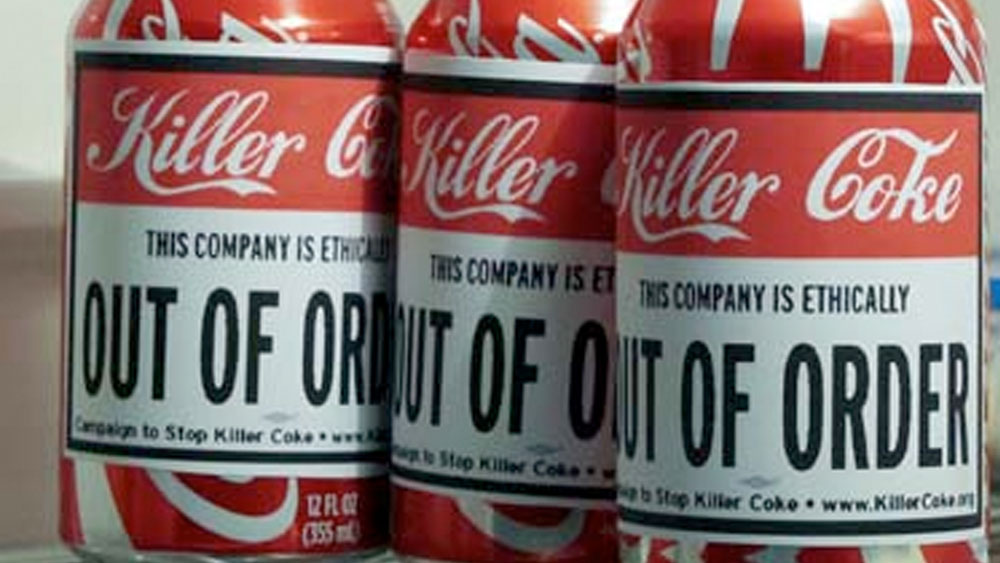
ORDER STICKERS & FLYERS

New Stickers and New Half-Size Flyers

Click for All New Stickers

Print out three of the new stickers.
You can use Avery Standard Labels #5164, six to a page.

Print out three more of the new stickers.
You can use Avery Standard Labels #5164, six to a page.

Click for All New Half-Size Flyers

Order Posters, Stickers and Leaflets

THE TWO FACES OF COCA-COLA

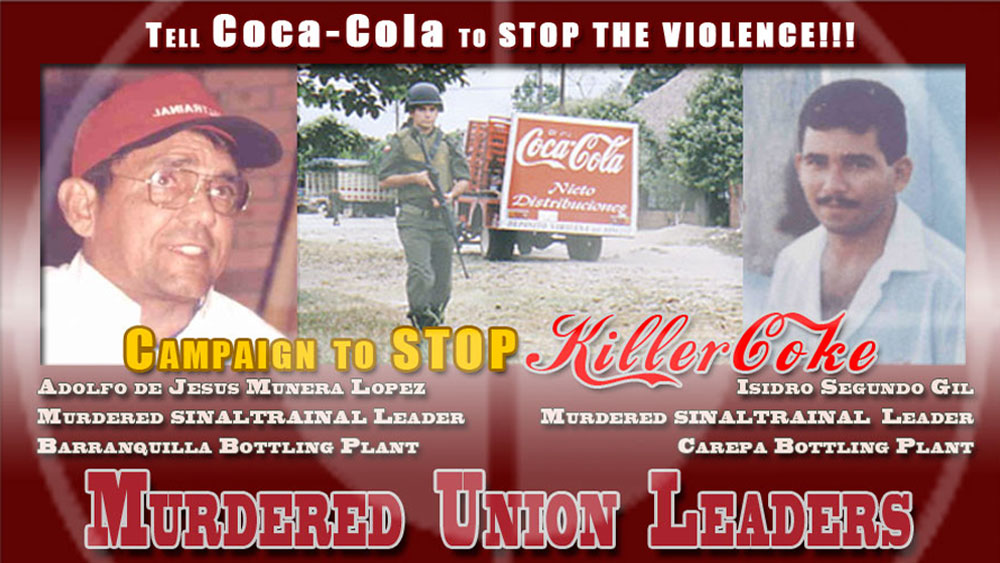
Isidro Segundo Gil, an employee at a Coca-Cola bottling plant in Colombia, was killed at his workplace by paramilitary thugs. His children, now living in hiding with relatives, understand all too well why their homeland is known as "a country where union work is like carrying a tombstone on your back. Learn More

Douglas Daft, former Chairman and CEO of the Coca-Cola Co., raked in more than $105 million in compensation for 2001. He owns 3.5 million Coke shares and 9,413 shares of SunTrust, where he sits on the Board of Directors. Since this brochure was written, there have been a number of changes in the Board of Directors Learn More

Read "The SunTrust/Coca-Cola $ix-Pack: Getting Away with Murder"
Read "The SunTrust/Coca-Cola $ix-Pack: Getting Away with Murder" — En Español

Dear Coca-Cola Board Members,

I am shocked to learn of your indifference to the safety of workers who bottle your products. There are undisputed reports that Coca-Cola bottling plant managers in Colombia, South America, allowed and encouraged paramilitary death squads to murder, torture and kidnap SINALTRAINAL leaders and members in an effort to crush their union. Since this leaflet was written, there have been a number of changes in the Board of Directors

Download Petition
Download Petition (ESP)
Download Petition (FRA)
Download Petition (ITA)
Download Petition (GER)

Dear SunTrust Banks Board Members,

If "The Real Thing" won't do the right thing in Colombia and elsewhere, SunTrust should sever all ties to Coca-COla."

Download Petition

Royal Bank of Canada:


'Dump Reinhard from Your Board or We'll Dump You!"

Download Petition in English
Download Petition in French

Stand up for Labor and Human Rights


Boycott SunTrust, the Bank of Killer Coke

Download Flyer

Find a leaflet customized for your college, university, high school, union or community. If you don't see it here, contact us at stopkillercoke@aol.com and we will customize one for you.

Go to our list of customized flyers

Click here for Coke Flyer Side 1 — Click here for Coke Flyer Side 2


REPORTS


Click here for our Reports section

Coca-Cola Board of Directors


The following information is to help individuals and groups communicate their feelings directly to the top policymakers of The Coca-Cola Co. Groups may want to organize leafletting, demonstrations and letter writing campaigns at the principal offices of these directors: View Contact List

2010 Complaint on behalf of Coca-Cola workers in Guatemala against The Coca-Cola Co.
"This case involves a campaign of violence—including rape, murder, and attempted murder—against trade unionists and their families by Coca-Cola bottling and processing plants in Guatemala under the control and supervision of the management of Defendant the Coca-Cola Company."

Press Release from Campaign to Stop Killer Coke

SINALTRAINAL et al, v. The Coca-Cola Company, et al., March 31, 2008
View Plaintiffs' Opening Brief
Summary: Advancing the legal efforts began with the United Steelworkers Union in 2001, IRAdvocates is working to hold Coca-Cola accountable for the murder and torture of trade union leaders in Colombia. This case also pioneered the use of a focused corporate campaign tied to the demands made by the Plaintiffs (see www.Killercoke.org). The case is currently pending in the 11th Circuit, and the parties have been in protracted discussions in an effort to resolve the issues.

Status: Plaintiffs' Opening Brief in Sinaltrainal, et. al. v. The Coca-Cola Company, et. al. was filed in the 11th Circuit Court of Appeals on March 31, 2008

International Labor Rights Fund, "ILRF & USW Bring New Complaint Against Coca-Cola, Alleging Complicity With the Colombian DAS and AUC Paramilitaries In Killing of Labor Leader," June 2, 2006
Read Press Advisory
"On Friday, June 2, 2006, the ILRF and USW filed a new Alien Tort Claims Act case against the Coca-Cola Company and its Latin American Bottler, Coca-Cola FEMSA. This new Complaint charges that managers at the Coke bottling plant in Barranquilla, Colombia conspired with both the Colombian Administrative Department of Security ("DAS") and the AUC paramilitaries to intimidate, threaten and ultimately kill SINALTRAINAL trade union leader Adolfo de Jesus Munera on August 31, 2002. The Complaint further allege that, despite a number of warnings to Coca-Cola management in Atlanta that the management at the Barranquilla bottler has continued to meet with and provide plant access to paramilitaries, the paramilitary infiltration of this bottling plant continues unabated to this day. Meanwhile, these same paramilitaries have continued to threaten SINALTRAINAL members and leaders with death and even kidnapped the child of one SINALTRAINAL leader to pressure him into refraining from his union activities."
Read 2006 Complaint

ATCA Complaint Against Coke — Coca-Cola (Coke) Sued for Human Rights Abuses in Colombia: United Steel Workers Union and the International Labor Rights Fund, July 20, 2001
Read 2001 Complaint

ATCA Complaint Against Coke sued by Turkish Coca-Cola workers victimized by riot police under orders from Coca-Cola

Case Name: TURIDI et al. v. THE COCA-COLA COMPANY et al.

Plaintiff: Turkish Coca-Cola workers victimized by riot police under orders from Coca-Cola

Summary: In 2005, 105 workers at a Coca-Cola bottling plant in Istanbul Turkey joined a union and were terminated. They organized a lengthy sit-down strike in front of the main offices of Coca-Cola in Turkey. After several weeks of protesting, the workers entered the building to demand their reinstatement. While leaders of the workers were meeting with senior management for the company, the company ordered Turkish riot police to attack the workers who were by all accounts peacefully assembled, many with their spouses and children. Nearly two hundred of them were beaten badly and many required hospitalization. The victims sued for torture under the ATCA, as well as battery, assault, emotional distress under New York state law. They also brought claims for unfair business practices because Coca-Cola has been representing to the public that they are not an anti-union company and they require their bottlers to respect fundamental worker rights. The case was initially dismissed on forum non conveniens grounds, with the Court ordering the case transferred to Turkey. Plaintiffs instead appealed to the Second Circuit Court of Appeals, where the case is pending. The case is currently pending in the 11th Circuit, and the parties have been in protracted discussions in an effort to resolve the issues.

Status: Pending in appeals court

"10 Critical Talking Points," February 14, 2007
Read Talking Points in html

Webcast of 2008 Coca-Cola annual shareholders meeting, April 16, 2008
Watch Webcast of 2008 Shareholders Meeting.

Webcast of 2007 Coca-Cola annual shareholders meeting, April 18, 2007
Watch Webcast of 2007 Shareholders Meeting

Webcast of Coca-Cola's 2006 Annual Shareholders' Meeting, April 19, 2006
Watch Coke's 2006 Annual Shareholders' Meeting

The Coca-Cola Co., 2005 Annual Shareowners' Meeting Webcast, April 19, 2005
Watch Coke's 2005 Annual Shareholders' Meeting

"University of Michigan Falls Prey to Another Coca-Cola PR Scam," Campaign to Stop Killer Coke
April 17, 2006 Press Release/Report

WB11, New York Feature on the Campaign to Stop Killer Coke
On July 11, 2005, WB11, one of New York City area's major television stations aired a special "Fact Finders Report" on the Campaign to Stop Killer Coke called "Coca-Cola Faces Human Rights Violations." Interviewed are Campaign Director Ray Rogers, Hofstra University Campaign Activist Vanessa Cudabac, New York City Council Member Hiram Monserrate, New York City Comptroller William Thompson and American Postal Workers Union (APWU) Secretary-Treasurer Terry Stapleton. This excellent feature was watched by millions on WB11 and, as we found out from supporters, watched by others around the world on satellite television.

See WB11 News Feature
Read the Campaign's response to Coke's lies in this feature.

Video, "State of the Union" The story of Coke in Colombia, produced by Insight News for Channel 4 of Great Britain in Spanish with English subtitles
Watch Video

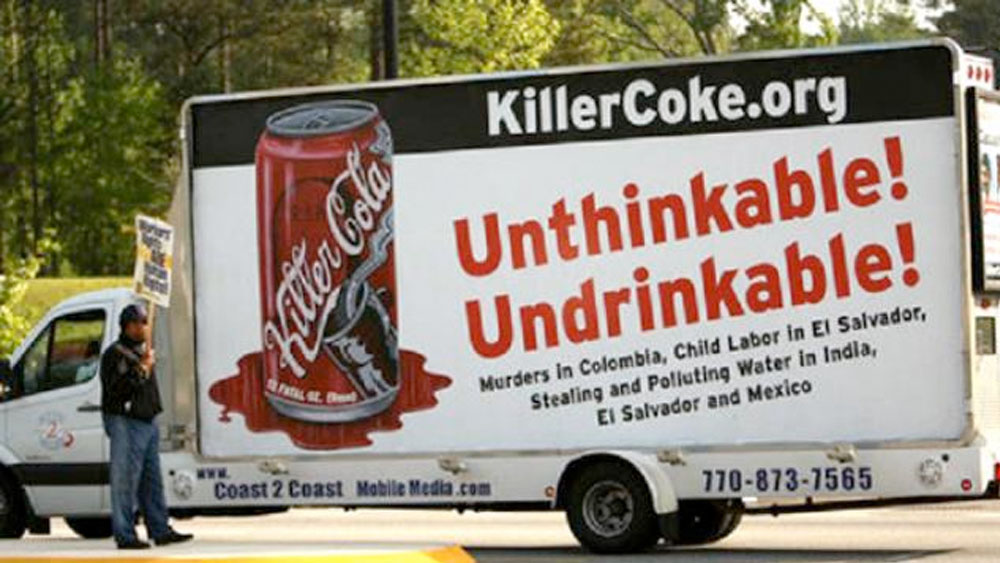
"Unthinkable! Undrinkable! A Campus Campaign Overview," a USAS Campus Guide
Read USAS Campaign Overview

War on Want, Press Release and Report, "Coca-Cola under fire as World Cup comes to London, Released March 20, 2006
Read Release
Read Report, "Coca-Cola: The Alternative Report"
En Español
War on Want's Coke Campaign Site

Colombia Solidarity Campaign, "The Anti-Coke Manifesto," By Andy Higginbottom, Secretary, Colombia Solidarity Campaign
Read Manifesto
Read Manifesto in Italian

LABOR AND HUMAN RIGHTS: 'The Real Thing' in Colombia, By Lesley Gill
Read Report

"Inside the Real Thing: Corporate profile on Coca-Cola Corporation," Report by the Polaris Institute (Canada)
Read the report in pdf format

McMaster University, "Anti-Monopoly, For Choice: An Evaluation of Coca-Cola Ltd.'s Presence at McMaster University"
Read Pamphlet

NYC fact-finding delegation's report on human rights violations by Coke — Final Report, NYC Council Member Hiram Monserrate, April 2004
View Full Report in pdfhtml
View Appendices
Monserrate Report in Italian -- pdf format
Monserrate Report in Italian -- html format

International Labor Rights Fund, "Another "Classic Coke" Move to Deny and Delay Accountability for Human Rights Violations in Colombia," March 4, 2006
Read Response

"Proposal of the New York City Pension Funds for an Independent Investigation of Allegations Made Against Coca-Cola Bottling Plants in Colombia
Read Proposal and Letter from the Office of the Comptroller of New York City

How Credible is Coca-Cola? Beyond Coke's Crimes in Colombia:
This is a summary of Coke's abuses outside Colombia which should be very useful for public relations and organizing efforts. We're anxious to receive articles and other information that we can use to further document the case against Coke. We believe the evidence shows that Coca-Cola and its corporate network is rife with immorality, corruption and complicity in murder. Since Coca-Cola consistently fails to live up to the standards for "corporate responsibility" as set out in its own "code of business conduct," this report should be helpful to students, faculty and others seeking to rescind, not renew or not consider contracts with Coke.
View Full Report

Seven Points to Settlement
Read the Seven Points.

"ILRF Director Terry Collingsworth Response to Coke's Denials," July 8, 2004
Read Response

Schools Active in the Campaign to Stop Killer Coke
Read Report

"Why Does the IUF Attack SINALTRAINAL?"
Read Report in pdf format.
Read Report in html format.

Historic Settlement: Ingram vs. The Coca-Cola Company (for racial discrimination)
Read About the Lawsuit

United Students Against Sweatshops' Statement, "Cal-Safety Compliance Corporation is Not a Credible Monitor for Coca-Cola's Labor Practices," April 15, 2005
Read Report
"… there are ample grounds to conclude the Cal-Safety is unfit to monitor Coca-Cola's labor practices in Colombia. Indeed, given its repeated failure to find egregious violations in high profile cases of worker abuse, its status as a for-profit corporation, its practice of monitoring generating revenue from the major corporations for whom it monitors, its lack of experience with the core issue of freedom of association, its flawed methodology in visiting factories and conducting worker interviews, and its utter lack of transparency, Cal-Safety should easily be ruled out as a candidate for credibly investigating the case of Coca-Cola in Colombia."

Coca-Cola Brands


(It should be noted that some of the listed brands are NOT produced by Coke, but are distributed by Coke in some regions, including A&W and Schweppes.)

The Coca-Cola Co.
The Coca-Cola Company's Brands (A-Z)
Full List

Responsible Shopper
Responsible Shopper (Co-op America): Coca-Cola Analysis, Brands and Companies
Analysis of Coke


Alternatives to Coca-Cola

(In addition to these alternative companies, you might find local beverage companies. In some regions, Coca-Cola might be distributors of the alternative beverages; for example, in some regions, Cadbury Schweppes products such as Dr. Pepper are distributed by Coke.)

Read List of Coke's Competitors

Adirondack Beverages United States, mostly in the Northeast

Afri-Cola, Germany

Auvergnat Cola, France

Barr Soft Drinks , Scotland

Ben Shaws (UK)

Big Cola, Mexico

Blue Sky Natural Soda, United States

Breizh Cola, Brittany, France

Bolthouse Farms, United States, Canada & Puerto Rico

Boylan's Premium Beverages, Williamsville, New York, US

Charlie's Soda Co., Australia/New Zealand

Faygo Beverages, Detroit, Michigan, USA

Fentimans, Riding Mill, Northumberland, UK

Fizzy Lizzy, United States, Japan, Bermuda and St. Barts

GuS Grown-Up Soda, New York, NY, US

Hank's Beverages, Trevose, Pennsylvania, US

Hansens Natural Soda, United States

Hosmer Mountain Soda, Connecticut, U.S.

Jones Soda, Seattle, Washington, US

R.W. Knudsen Spritzers and Juices, United States

Polar Beverages, New England, U.S.

Santa Cruz Organic Spritzers and Juices United States

Steaz Green Tea Soda, Newton, Pennsylvania, US

The Switch Beverage Co., United States

Tommy's Naked Soda (U.S. Northeast)

Ubuntu Trading, (Fair Trade), UK

Zevia (United States)

There have been

visits to this website
since Oct. 4, 2004.